|
|
|
|
World Building
|
|
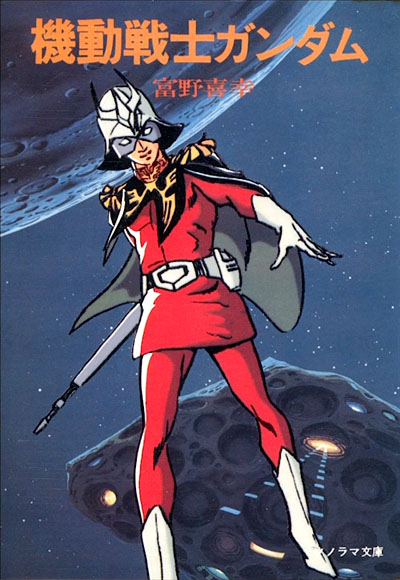
Toward the end of Mobile Suit Gundam's TV broadcast run, director Yoshiyuki Tomino made his debut as a novelist. His first Gundam novel was published by Asahi Sonorama at the end of November 1979. During the year-long gap between the end of the TV series and the release of the first movie compilation, Tomino completed the story with Mobile Suit Gundam II and Mobile Suit Gundam III, published in September 1980 and March 1981 respectively. All three novels were reprinted by Kadokawa Shoten in 1987. The storyline in Tomino's novels diverges dramatically from any of the animated versions. Most of the heroes are military cadets from the beginning, rather than civilian refugees. The action takes place entirely in space, and the later volumes extend the story with many additional characters and battles. Nonetheless, Tomino's digressions into the Gundam world's history, politics, and character backstories make for fascinating reading, even if we can never guarantee that they apply to the animated continuity. |
These novels were actually the first Gundam works to be officially released in English, in the form of a paperback series published by Ballantine's Del Rey imprint between September 1990 and February 1991. The translation was by the legendary interpreter and manga expert Frederik L. Schodt, who has written about the project on his personal web site. An updated single-volume edition was later published by Stone Bridge Press.
I've made my own translations of some noteworthy passages for reference purposes, along with some notes on the story. I can't compare with Schodt in terms of either Japanese language skills or English readability, but I didn't want to simply swipe chunks from his text, so I've aimed to be as awkwardly literal as possible to avoid duplicating his work. If you actually want to read Tomino's Mobile Suit Gundam novels, please enjoy Schodt's masterly interpretation in the Stone Bridge Press edition!
Incidentally, while the Kadokawa Shoten editions of the novels are largely identical to the original Asahi Sonorama versions, there are a few interesting additions and changes that I've noted along the way.
The following text is copyright © Sotsu • Sunrise.
Translator's Note: First published in November 1979 as simply "Mobile Suit Gundam," and reissued by Kadokawa Shoten as "Mobile Suit Gundam I." Released in English as "Mobile Suit Gundam Volume I: Awakening," it corresponds to chapters 1 through 8 of the single-volume Stone Bridge Press edition.
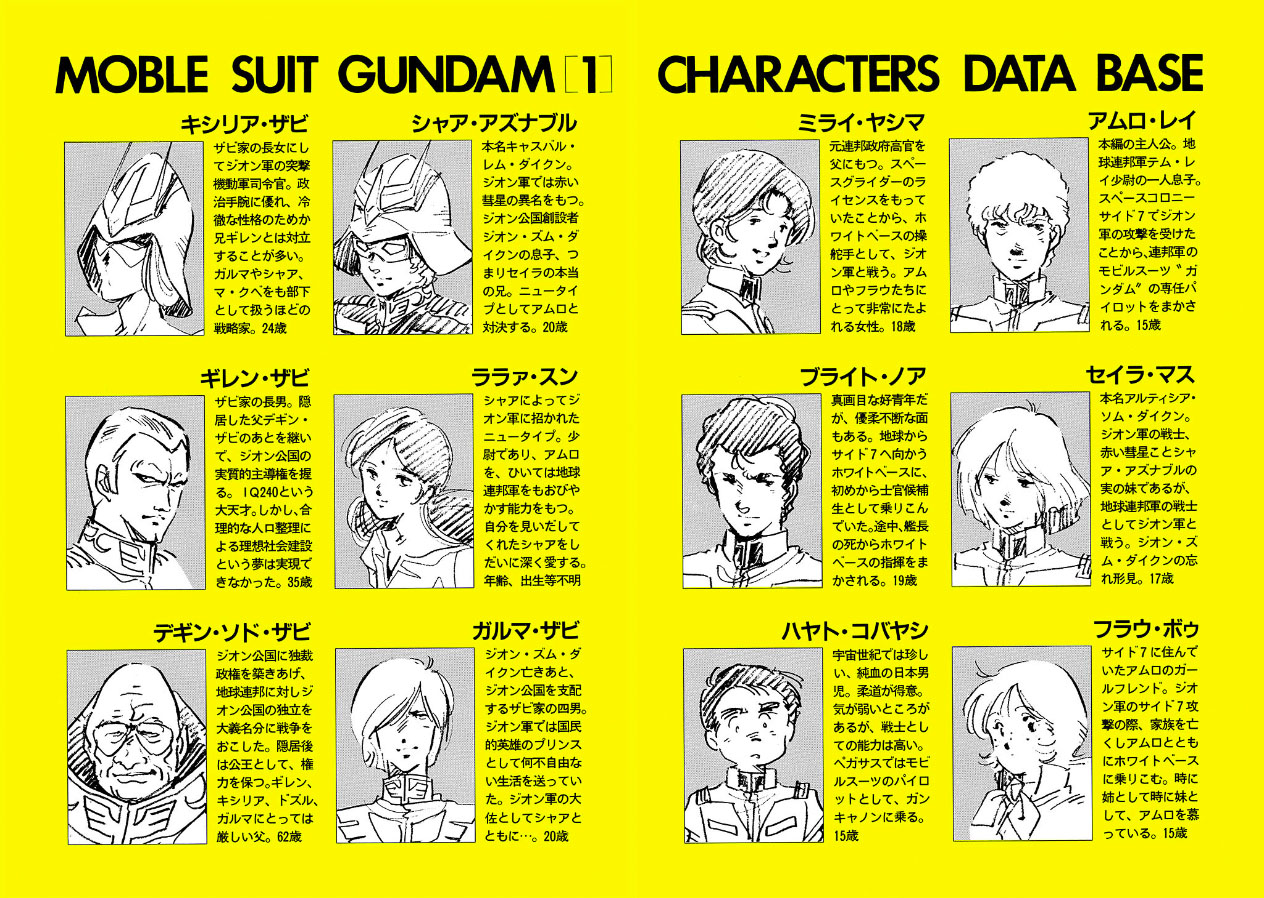
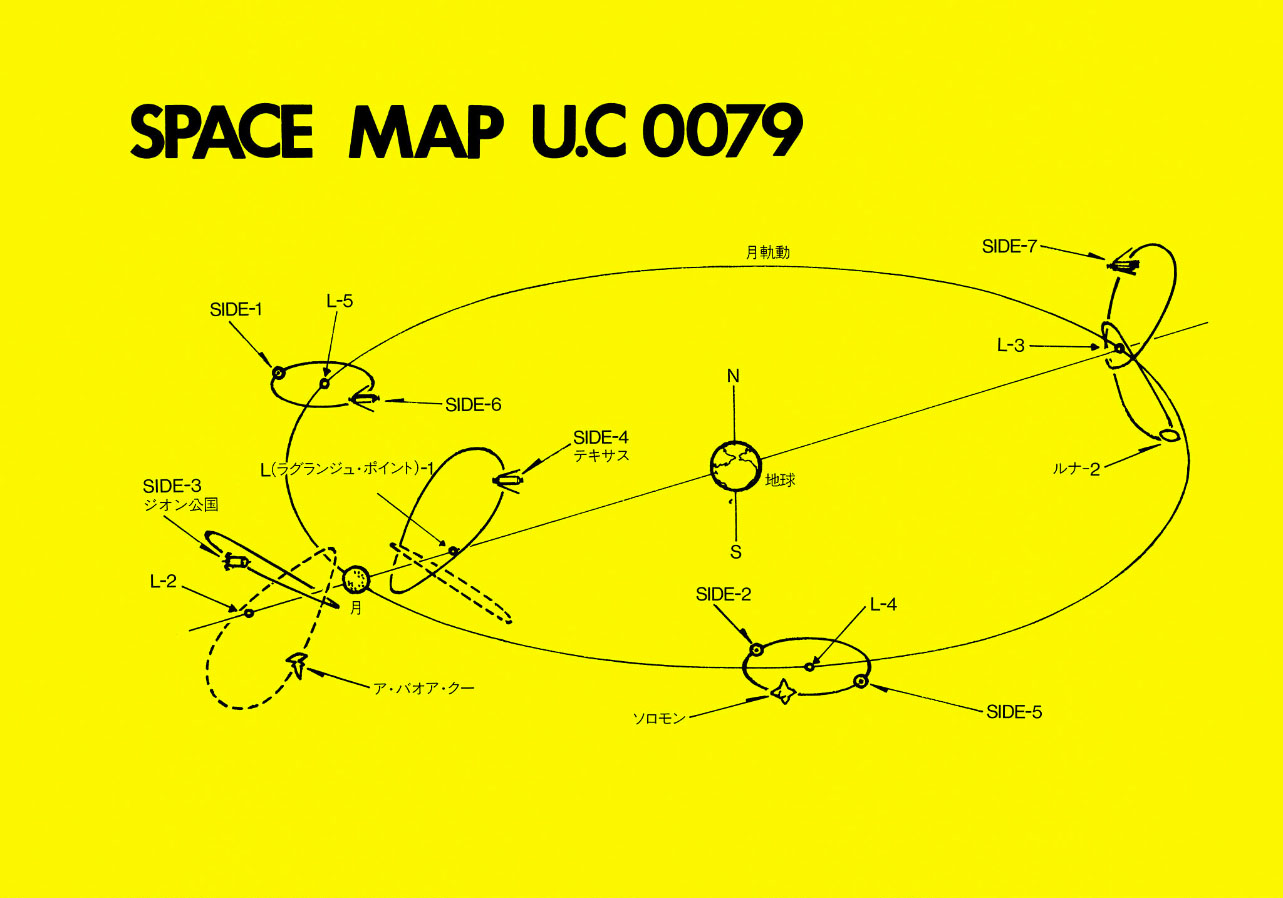
Data pages from the Kadokawa Shoten edition. The ages listed in the character database are as per the animated version, rather than the novel itself. Likewise, the space map is based on the one used in the animation from Z Gundam onwards, and doesn't match the Side locations described in the text of the novel.
The story begins with the White Base, here called the Pegasus, on its way to Side 7 to collect the Earth Federation's new prototype mobile suits. In this version of the story, Amuro Ray and most of the other heroes are already military cadets assigned to the Pegasus, and everyone seems to be a couple of years older than their animated counterparts. It's never clearly stated how old Amuro is in this version, but Sayla is 20 years old at this point, and in the second volume we're told that she's a year or two older than Amuro.
The focus then shifts to Char Aznable aboard his Musai cruiser, and we get a little explanation about the asteroid base Luna II.
Luna II was originally an asteroid named Juno, part of the asteroid belt that lies between Mars and Jupiter. This was moved into the Moon's orbital path to provide the mineral resources required for more than two hundred colonies. It had been gradually whittled down until nothing remained of its original shape, and it was now a lemon-shaped mass with a maximum diameter of over eighty kilometers. About twelve years earlier, it had been stationed at a stable point in orbit opposite the Moon.
Since before the outbreak of war, this area had been fortified as a base for the Earth Federation's space forces, and Zeon cruisers were seldom able to infiltrate it. (1) Nonetheless, patrol units from both sides were constantly crossing paths in this shoal zone, and it was the scene of repeated minor skirmishes.
Char's subordinates report some information about the Side 7 colony.
"How long ago did the settlement of Side 7 begin?"
"About two and a half years ago, Lieutenant Commander Char."
Lieutenant Junior Grade Dren, ten years his senior, gave a polite reply.
"Side 7's first colony was only about one-third finished when the war broke out, so you could say it's still an untamed wilderness."
"I see. And it's also within Luna II's air supremacy zone..."
Char broke off as something occurred to him. The wooden horse's shape, and the fact it was headed for Side 7...
"Is this Operation V? Have the Earth Federation Forces completed their own mobile suits?"
"Mobile suits? The Federation has them too?"
Lieutenant Dren's response was skeptical, and Char was irritated by his stupidity. But he'd come up through the civil service, so it couldn't be helped.
"Are there any forces stationed at Side 7?"
"There are, sir. A single unit under the Colony Management Ministry, the 8th Company of the Third Regional Patrol Force. That's intelligence from two months ago."
A young soldier called this out from in front of a monitor.
"That's old information. It just shows how short-handed our own forces are."
"Sir! And according to data from seven months ago, there are 13,800 civilians, but..."
"Understood, Kim."
We then segue into an extended history lesson...
It was now year 0079 of the Universal Century calendar, whose year zero commemorated the year in which humanity first expanded into space. (2)
Half a century had passed since policies were adopted to peacefully resolve the near-insane growth of Earth's population through space colonization. (3) The space emigration plan known as the space colony project, which was proposed in the latter half of the twentieth century of the old Common Era, was implemented. Construction of the space colonies which were just a pipe dream in the good old days began with cylinders more than three kilometers in diameter and thirty-two kilometers long, but colonies were now being built that had twice that volume.
The Asahi Sonorama edition says: "Construction of the space colonies which were just a pipe dream in the good old days began with cylindrical 'islands' more than six kilometers in diameter and thirty-two kilometers long, but colonies were now being built that were three times that size." It goes on to claim that the Side 7 colony is 18 kilometers in diameter, which seems excessive.
Earth was consumed by a pervasive sense of crisis, a characteristic evil of the late stages of finite oil-based civilizations. Only the worst vices of capitalism remained, making it impossible to lead a stable, civilized life. What's more, energy consumption that relied on burning fossil fuels was intensifying Earth's greenhouse effect. Energy transmission using solar cells risked destroying Earth's ozone layer, exposing the surface to radiation damage. Humanity had to prevent the destruction of Earth's natural systems by its own rising population, so there was no choice but to forcibly carry out space emigration. This was done through the power of the state, without regard for people's local identities.
Humanity's only goal was to avoid the folly of ruining the planet, destroying Earth's natural systems with its population growth.
Forty colonies were initially constructed at the fifth of the Lagrange points, which could be thought of as neutral points between the gravity of the Sun, Moon, and Earth. Each colony cluster was called a Side. Two clusters, Sides 1 and 4, were located at Lagrange point 5. Sides 2 and 6 were located at Lagrange point 4, Side 5 was at Lagrange point 1, and Side 3 was constructed at Lagrange point 2, commonly referred to as the far side of the Moon. (4)
By Universal Century 0045, Luna II was in place, and emigration to Sides 1 and 2 had been completed. Around the time Side 3 was established as an emerging new Side—followed in rapid succession by the construction of Sides 4, 5, and 6—the idea of separation from Earth began to emerge from the two existing Sides.
At this point, the Asahi Sonorama edition adds: "The emigration to space had been carried out in a semi-compulsory fashion, and antagonism was gradually becoming apparent between the space colonists and the people who remained on Earth. But resources were dwindling, and the Earth Federation government couldn't allow any further destruction of Earth's natural systems by the rising population, so there was no way the space colonization program could be halted."
Once settlement had been completed as far as Side 6, the final colonization plan was to end with the construction of Side 7. At this point, as a century-long emigration project was about to conclude with eighty percent of humanity's total population becoming space residents, a faction emerged of people who wanted to remain on Earth.
These people secured key positions within the Earth Federation government, in the hope that they alone could continue living on Earth as one of its indigenous species. Nonetheless, they didn't want to give up control over the Spacenoids, the people who had emigrated to the space colonies.
With this, the antagonism between the space colonists and the people who remained on Earth came to the forefront. This antagonism reached its height with the establishment of the Principality of Zeon, an independent government based at Side 3.
This was preceded by Zeon Deikun's declaration of a Colony Republic in U.C.0058. (5) The young revolutionary named Zeon, however, died four years later. He was succeeded by Degwin Zabi, but the Earth Federation government still refused to recognize the colonies' autonomy. Even though the majority of humanity had become space-dwellers, the people who remained on Earth wanted the planet's surface to be the seat of authority.
But could the Sides really be managed by looking up at them from Earth? This was an example of how antiquated the Earth-type mindset was. (6) Faced with this unilateral imposition by the Earth Federation, Degwin Zabi concluded that the only choice was to demonstrate their independent power, and humanity set out on the road to a war in space.
In order to unify the space colonists, Degwin Zabi announced the establishment of the Principality of Zeon system, and Side 3 organized its own armed forces. This military buildup was based on the discovery of the Minovsky particle.
These microscopic particles had various kinds of electrical properties, and when they were dispersed, they fused with plasma in outer space to create an unstable ionic state that reflected and absorbed radio waves. These were known as Minovsky particles after their discoverer. Their drawback was that they were very short-lived, so they had to be continually dispersed, but they fundamentally altered the nature of space combat.
The Asahi Sonorama edition is more specific about the lifespan of the Minovsky particle: "Their drawback was that they were short-lived, lasting less than a month, so they had to be continually dispersed."
In short, thanks to this particle, it became basically impossible to use radio-based weapons such as radar. It was Gihren and Kycilia, two capable members of the Zabi family, who developed the weapon that would be most effective under these conditions.
The weapon they developed, the mobile suit Zaku, could overcome the adverse effects of the Minovsky particle by engaging in close combat. This enabled the Principality of Zeon to launch what they called the "Zeon War of Independence."
The One Week Battle at the beginning of the conflict went just as Gihren and Kycilia had planned.
The mobile suit Zaku was powered by a nuclear fusion engine like that of a warship, giving it a tremendous combat duration. It could also switch between different kinds of firearms depending on the tactical situation, enabling close combat even under Minovsky particle conditions. With its hit-and-run attacks and tactic of charging straight at the enemy, the Zaku could sink even the Earth Federation's Magellan-type battleships.
The Asahi Sonorama edition phrases this more clearly: "The existence of the Minovsky particle made close combat possible, and the Zaku's tactic of charging straight at the enemy, rather than the hit-and-run attacks previously performed by fighter craft, enabled it to easily sink the Earth Federation's Magellan-type battleships."
It was conceived of as a human-operated suit, and when the machine was heavily armored with a triple-layered composite honeycomb structure, it barely fit within a height of sixteen meters. Thus, in some respects the Zaku was inconvenient for its pilots. It was hard to get in and out of the cockpit, since the entrance was right in front of the control panel. This may not seem like a problem in zero gravity, but it was unpopular since the panel tended to get dirty.
Again, the Asahi Sonorama edition is clearer: "With the addition of heavy armor, what was conceived of as a human-operated suit expanded to a gigantic height of sixteen meters. But even this was barely large enough to accommodate armor with a triple-layered composite honeycomb structure, which was required since it was originally meant for use alongside nuclear weapons."
The Zaku's 120mm rifle was called a rifle because it was held in its hard, but it was really an artillery gun, which the Zaku employed at close range. One result was the emergence of pilots such as Char, who sank three Magellan types and seven Salamis-type cruisers with a single Zaku. Due to his accomplishments, Char had received a special promotion to lieutenant commander, and his red Zaku was now dreaded by Federation Forces soldiers as the "Red Comet."
Char dispatches two Zakus to infiltrate Side 7, and a battle begins within the colony.
As the Pegasus pilot cadets rush to join the fight, Amuro recalls his previous life at Side 7. This account seems to contradict the previous claim that settlement of the colony began just two and a half years earlier. But it appears consistent with chapter 6, where Amuro says that he lived at Side 7 for two years before joining the military.
"I wonder if Fraw Bow's okay?"
Amuro was thinking of a girl one year younger than he was, who had been his neighbor ever since he moved to Side 7 four years earlier. For Amuro, who had been living alone with his father, Fraw Bow's mother had been a mother to him as well. She was a generous and attentive woman, and Fraw Bow, raised by such a mother, had been an even kinder girl. His first love? It wasn't that clear-cut, but that wasn't wrong either. The C Block into which he was now descending was where Amuro and Fraw Bow had both lived.
Amuro activates the Gundam and destroys one of the enemy Zakus, which explodes inside the colony.
Char watches from outside the colony, and we get a brief discussion of his secret identity and his relationship to Zeon's ruling Zabi family.
"They don't trust me."
That's what Char thought as he watched the light of the explosion from the colony.
His only options were to send reinforcements to attack the colony, or to retreat. In terms of his combat record, the latter option didn't appeal to him. Right now, what mattered to him was that he, Char, would be the one to obtain intelligence on the Federation's mobile suits. Rapidly advancing in the ranks was the only way he could get closer to the Zabi family.
His father Zeon Deikun had actually founded the Republic of Zeon, and the current sovereign Degwin Zabi had been his father's ally. About fourteen years ago, following his father's death, Degwin had discarded the republican system and replaced it with a principality, banishing the republican faction that Deikun left behind. These political changes hadn't mattered to the young Char, but under the tutelage of his foster father Jimba Ral, he came to develop aspirations of overthrowing the Zabi family. It was Jimba Ral's belief that Degwin might have assassinated his father Zeon Deikun—no, that Degwin had assassinated him.
Char became determined to someday take revenge on Degwin, and when he turned fifteen, he entered Zeon on his own. Assisted by members of the former Deikun faction, he secured a family registration as Char Aznable, and went from high school on to military academy. (7) It was at this academy that Char befriended Garma Zabi, Degwin's youngest son.
Then the war began. It was only natural that Char thought of all this as a means to seize control of Zeon for himself. Moreover, what was supposed to be a brief decisive battle had turned into a war of attrition. The Principality of Zeon had quickly become a dictatorship of the Zabi family, but this might shake the foundations of their system. Meanwhile, he could rally the former Deikun faction and bring down the Zabi family from within. But Char had no intention of entrusting the Principality of Zeon to the bureaucratic society of the Earth Federation government and its absolute democracy.
Char leads a commando team into the colony, where his long-lost sister Sayla Mass is in the process of evacuating to the Pegasus. The chronology here seems consistent with the dates previously given for the establishment of Zeon Deikun's republic and his subsequent death.
Sayla Mass was twenty years old as of that year. Two years earlier, she had voluntarily emigrated on her own to Side 7. By the late U.C.0070s, few people volunteered to emigrate, and generally they were forcibly compelled. The only people who were still allowed to remain on Earth were those with a traditionalist attitude toward the planet, and those with special privileges who had some kind of relationship to the Earth Federation government.
Sayla had good reasons for emigrating by herself. She and Char were brother and sister, the children of Zeon Deikun.
Their father Zeon had died when she was three years old. Char and Sayla, under the protection of Zeon's close aide Jimba Ral and his wife, fled the Republic of Zeon and took refuge on Earth. The Rals had amassed a vast fortune in preparation for their escape. They used this to purchase the name of the distinguished Mass family of southern Europe, and raised Sayla and Char while posing as members of Earth's elite society. (8)
Sayla Mass was the name she'd been given at that point. Her real name was Artesia Som Deikun. Char's name within the Mass family had been Edouard Mass, and his real name was Casval Rem Deikun.
As they raised the children, Jimba Ral and his wife took every opportunity to tell them that their father Zeon had been assassinated as part of a plot by Degwin Zabi. Casval became convinced that he had to take revenge on the Zabi family, and he decided to enter Zeon when it was time for him to begin high school.
But Sayla, or rather Artesia, had her doubts about her brother's beliefs and way of life. What's more, her brother Casval had been kind to her. Artesia didn't want to lose a brother like that.
When she learned that her brother was leaving for Zeon, Artesia wept for three days and nights. And from that moment on, she began to hate her foster parents. To Artesia, the family mantra that the Zabi family must be punished became hateful, and she herself started to change. Just as she'd decided she had to flee her foster parents, she learned that construction of the new frontier of Side 7 was underway. However, it took her a year to persuade the aged Jimba Ral to let her emigrate alone.
"Would a father take pleasure in his child's unhappiness?"
With these words from Artesia, Jimba Ral finally gave up.
"If that is your wish, Mistress Artesia..." (9)
Sayla had decided to become a doctor, and as the Side's construction began, she came here to Side 7's first colony to enroll in the central technical training academy that would support the future Side. Thus she would forget the name of Zeon, and the name of Zabi...
With the outbreak of war, however, she could no longer avoid the conflict. She was conscripted into military service, and just over half a year later, she had been qualified as a radio operator. She had then gone on to become a civilian military employee.
These days, female soldiers (or WAVES) made up a quarter of the Federation Forces and other militaries. (10) The proportion of WAVES was particularly high in the supply corps, communications, and manufacturing, as the military wanted all the high-quality personnel it could get. But Sayla couldn't bring herself to fight against the nation that bore her father's name, even if it now represented a society with a very different political system.
An event was about to take place, however, that would shake her resolution.
After a brief encounter with Sayla, Char exits the colony. The heroes depart aboard the Pegasus, and Amuro and Char fight a brief space battle in their mobile suits. This leads to the first mention of Newtypes in the novel.
The white mobile suit had evaded him. How?
"Could he be a Newtype?"
Char considered something unthinkable.
"...That's impossible."
At the very least, nobody in the Federation Forces could have had the Newtype concept in mind. It was a concept that Char himself had first come across just a few months ago. He had learned of this theory of human reformation when he made contact with the Flanagan Agency.
Char didn't want to believe that the white mobile suit was operated by such a Newtype. Surely the Federation must have some people who were simply good at fighting. What had initially looked like the moves of an amateur were now being executed perfectly, and Char didn't feel that this progress was merely the enemy putting on an act.
The extent to which various characters were previously familiar with the Newtype concept is, perhaps, a point on which the novels aren't completely consistent. It's possible these early chapters were written at a point where Tomino's ideas about the setting were still being finalized.
The third chapter begins with some more information on Luna II, the opening of the war, and Garma Zabi's personal history.
The plan to move Juno from the asteroid belt between Mars and Jupiter to the Moon's orbital path was set in motion in U.C.0035. Ten years later, it had been stationed in the Moon's orbit. This was done to secure Juno's mineral resources, and to provide sediment for the land surface of space colonies. After this, Juno became known as Luna II, and it traveled around the Moon's orbital path in response to the demands of the space colonies. When the construction of Side 7 was decided in U.C.0067, it was placed in orbit on the opposite side from the Moon.
By this point Luna II, which was now a lemon-shaped mass with a maximum diameter of over eighty kilometers, was also serving as a base for the Earth Federation's space forces.
Soon after the construction of Side 7 began, the Principality of Zeon launched a war against the Earth Federation. At the opening of hostilities, Zeon simultaneously attacked Sides 1, 4, 2, and 5, annihilating well over a hundred colonies in a single stroke. This initial fighting was collectively known as the One Week Battle. At the same time, missile attacks also rained down on Luna II, destroying any facilities which weren't buried underground. The Earth Federation Forces lost a third of their warships with no serious resistance.
The only exception was the resistance of the Revil fleet which had entered Side 5. Having failed to wipe out this fleet during the opening of hostilities, Zeon devoted the majority of its remaining fighting strength to launching a second attack. The Earth Federation Forces mustered their own fighting strength to meet the enemy, and the first large-scale space fleet battle in human history began.
The tragic result of the Battle of Loum was the loss of the majority of both fleets, along with the colonies of Side 5.
During the more than eight months that followed, the Earth Federation Forces scrambled to rebuild Luna II, and to refit and expand their fleet. The Principality of Zeon, meanwhile, sought to secure its hegemony over space by establishing the Granada fortress on the Moon and the space fortress Solomon in the airspace that was previously Side 1. Fighting also continued over smaller strategic bases, as both sides tried to expand their own territory in each area.
One such Zeon base was California. (11) This was a high-altitude artificial satellite, orbiting at a thirty-degree angle to the plane of the ecliptic, where Zeon reconnaissance forces were stationed. Its main missions were reconnaissance against the Federation Forces on Earth, and monitoring Luna II. In order to avoid direct attacks from the Earth Federation Forces at Luna II, its orbit constantly changed at random, and the maximum amount of Minovsky particles were dispersed in the space around it.
"We've detected the Federation's Operation V. We're chasing a wooden horse-type warship loaded with mobile suits towards you. Intercept and destroy it..."
The pale young man reading Lieutenant Commander Char's message was Captain Garma Zabi, who was effectively California's commander.
"Just like a man who was top of his class. Is he letting me take the credit?"
Garma Zabi smiled. With his right index finger, he twirled a strand of hair that hung down over his forehead.
The youngest son of Degwin Zabi, he had been barely eight years old when his father took the throne as Zeon's sovereign. Perhaps it was the environment that surrounded him after that, or perhaps just his natural temperament, but he'd grown up to be very trusting. Putting it charitably, he was generous to others, but that generosity made him too weak to be a good commander. Above all, he was simply too young.
Though Char had told him to wait for a second report, Garma was overcome with excitement. He ordered the base commander, Rear Admiral Zom, to launch three Gaw bombers.
Char attacks the Pegasus and its mobile suits once again, and Garma joins the battle, only to be shot down along with his Gaw. Along the way, we get a rare hint about the timeline of mobile suit development.
It was a humiliating incident. Mobile suits had been in practical use for barely two years, but Char's Zaku was probably the first one ever to be kicked by another mobile suit.
Witnessing the aftermath of Amuro's duel with Char, an unlikely character reveals some knowledge of Newtypes.
Ryu gasped when he saw the shield. A quarter of it had been destroyed, exposing a cross section of its honeycomb construction.
"It took that many hits?"
Ryu was stunned by the precision of Char's attacks, but also amazed by Amuro's ability in blocking these attacks with his shield.
"M-maybe... the guy's a Newtype..."
Ryu muttered a word he'd recently overheard.
Char, for his part, still seems to believe that Newtypes are a closely held secret.
Char turned his gaze in the direction of the Musai. He couldn't make out the Musai's silhouette amid the stars, but Dren was doing his job. Beams were shooting continuously toward the wooden horse.
"Is the wooden horse possessed by demons?"
Char was amazed that it hadn't taken a single direct hit amid the mega particle cannon fire of the Musai and Garma's Gaw.
"Demons... no..." Char recalled a term that made him shudder anew. "...Could it be a Newtype corps?"
As soon as he'd voiced the thought that came to him, he dismissed it as impossible. Only he and Rear Admiral Kycilia knew about Newtypes. And, of course, Dr. Flanagan Rom of the Flanagan Agency.
The Pegasus docks at Luna II, and Amuro learns that Fraw Bow's mother and grandfather were killed during the evacuation from Side 7.
Fraw Bow's mother had been closer to Amuro than his own father. Amuro had been parted from his mother at the age of six, and afterwards he had gone back to Earth about three times to see her. On those occasions, his mother Kamaria doted on him like a pet, but she still refused to leave Earth.
Amuro's father wouldn't force her, saying "I'm going to show Amuro the construction of a Side. That will make him a man strong enough to survive the new century..." This was the entire basis of his father Tem's educational philosophy.
Tem's fame as a colony architect must have given him enough influence with government officials for his mother Kamaria to escape the net of forced emigration. And Kamaria's insistence that she couldn't leave Earth may also have been a convenient excuse for the couple to separate.
When Amuro moved to Side 7, however, Fraw Bow's mother Fam had shown tremendous sympathy for Amuro's all-male household. Even if it was just out of charity, this was enough to quench a thirst within the motherless Amuro.
The Pegasus's surviving officers and pilots are summoned to meet with Luna II base commander Wakkein and the legendary General Revil. At this point we get more back story on the beginning of the war.
The war had broken out in January of the current year. The time lag between the Principality of Zeon's declaration of war and its space fleets' attacks on Sides 1, 2, 4, and 5 was just three seconds. People now referred to this as the "Three-Second Declaration."
The Principality of Zeon poured all its fighting strength into an operation unlike any in human history, attempting to drive the Earth Federation Forces to annihilation or surrender with a single blow. Each Side was made up of more than forty colonies, with a population of roughly one billion. The Zeon fleets set out to massacre them all, murdering a total of four billion people.
Zeon was able to do this because the method it had arrived at made it all too easy.
All it took was injecting GG gas into the sealed colonies. This was colorless and odorless. It took less than fifteen minutes to inject ten tons of GG gas, and in just over five hours, twenty-five million people would be dead. Zeon accomplished all this in just twenty hours, and had it then immediately demanded the surrender of the Earth Federation Forces, the latter might well have given up.
The Asahi Sonorama edition phrases this somewhat differently: "In fact, the general outcome was decided in less than twenty hours between the detection of the Zeon invasion and the injection of gas into more than 120 colonies. Had the Zeon forces then withdrawn and demanded the surrender of the Earth Federation Forces, the latter might well have given up. The Federation was shaken by the insane fact that four billion people had been killed in twenty hours. The shock was so great that, if Zeon had taken advantage of this opportunity, it could have forced the signing of a treaty of surrender."
However, when the Earth Federation government learned of the colony drop operation that directly followed the gas attacks, it chose to resist to the bitter end. The deaths of four billion people hadn't been reason enough. Human nature is a curious thing.
The people of Earth were shocked by the spectacle of the first colony falling onto New York. (12) The Earth Federation government launched a surprise attack on the Zeon forces, which were occupied with preparations to decelerate colonies and drop them onto Earth. (13)
The same peculiar idea was shared by Gihren and Kycilia of the Zabi family. They both believed that true victory in the war would come not through mass slaughter with gas, but through terrifying the elites on Earth by decelerating colonies and smashing them into Earth's major cities. After all, people perceive war through physical acts of combat.
This operation proved disastrous, though, in its use of Zakus. Large numbers of Zakus fell prey to the Earth Federation Forces during this colony drop operation. This was essentially what came to be known as the One Week Battle.
The Asahi Sonorama edition gives a somewhat different account of the colony drop: "However, human nature is a curious thing. The armed conflict that followed only made the Earth Federation Forces more determined to resist to the bitter end. Gihren and Kycilia were still fixated on attacking Earth itself, and they couldn't resist the temptation to terrify the elites on Earth with an operation that involved decelerating colonies and smashing them into Earth's major cities. Of course, this operation, which involved bombarding Earth's surface with massive quantities of nuclear weapons as well as using nuclear explosives to decelerate colonies and drop them onto Earth, proved disastrous in its use of Zakus. As they were occupied with decelerating the colonies, countless Zakus fell prey to the Earth Federation Forces. This colony drop was essentially what came to be known as the One Week Battle."
Still, Zeon had achieved its desired objectives. And one month after the One Week Battle, Zeon launched another attack on Side 5 (Loum), where its efforts had failed due to the resistance of the Revil fleet. General Revil mobilized his own remaining vessels in opposition, and a huge fleet battle began around Side 5, located between Earth and the Moon.
While the Zeon forces were inferior in terms of their number of vessels, they made up for this with their Zaku mobile suits. The Federation Forces lost the majority of their main fleet, and a Zaku team known as the Black Tri-Stars sank Revil's flagship and took Revil himself prisoner. It was mainly through this Battle of Loum that Lieutenant Junior Grade Char made his name as well.
At this point, Supreme Commander Gihren Zabi of the Principality of Zeon urged the Earth Federation government to surrender, and negotiations began in Antarctica. Here, Gihren Zabi said the following.
"Depending on the situation, perhaps you'll see Luna II crashing into the Earth Federation Forces headquarters at Jaburo."
The high officials of the Earth Federation government trembled at this threat. Jaburo, buried beneath South America, was the nerve center of the Federation Forces. It was obvious that if this were destroyed, then they'd have no choice but to submit to Zeon. Although the general consensus leaned towards the idea that unconditional surrender was inevitable, the Federation officials spent ten days debating the matter in Gihren Zabi's presence.
The Asahi Sonorama edition provides some additional details: "Not only would this kill fifty million people on Earth alone, but if it destroyed the nerve center of the Federation Forces beneath South America, it was obvious that they'd have no choice but to yield and submit to Zeon."
"This weakness is the cancer within the Federation. That's exactly what we must destroy."
With these words, Gihren Zabi returned to Zeon, leaving the rest to Rear Admiral Kycilia.
Three days later, on the day the surrender was finally to be signed, General Revil returned safely to Earth. From the Federation Forces' general staff headquarters at Jaburo, in a massive underground cavern beneath South America, he broadcast the message "There are no soldiers in Zeon."
We now get a full transcription of Revil's famous speech. I note that here, Revil seems fairly sympathetic to Degwin Zabi's criticisms of the Earth Federation government, reserving his harshest condemnation for Gihren and his personal ideology.
"I wish to appeal to every surviving citizen of the Earth Federation. Zeon no longer has any soldiers! It has no ships, no weapons, no ammunition! So why must we surrender to Zeon?! Fellow citizens! Those we need to defeat are the weak high officials of the Federation government itself. We cannot entrust the will of each and every Federation survivor to these officials who, hiding behind the pretext of absolute democracy, are unable to make a single decision!
"Remember the arrogant words spoken by Degwin Sodo Zabi when he seized control of the Principality of Zeon!
"Degwin claimed that the people of Zeon were a chosen people. He said that the people of the Earth Federation were old-fashioned people obsessed with old traditions, who didn't realize that humanity's consciousness was expanding as it began finding a home in the realm of space. He said the citizens of Zeon had no reason to obey a federation of such old-fashioned people!
"The corruption of the Earth-type bureaucrats is exactly as Degwin describes it. This may even be true of the Federation Forces as well. But citizens of the Federation, don't let yourselves be taken in by Degwin Zabi's one-sided truths. Zeon may be the Side furthest from Earth, but who could believe his nonsense about how they've gazed into the abyss of space?!
"It's unforgivable that Degwin Zabi would use the corruption of one part of the Federation as a pretext to claim legitimacy for the Principality of Zeon. This is nothing but the self-righteousness of the Zabi family that schemed to become dictators of Zeon. Even if we were to accept the Zabi family's dictatorship of Zeon, does that mean the Earth Federation itself must submit to the Zabi family as well?!
"The Earth Federation is a government founded on the principle of individual sovereignty. It was only because of the Earth Federation, a government embodying the wisdom of all humanity, that we could venture into space for the first time in human history. And yet Gihren Zabi says that the weakness of the Earth Federation must be destroyed! Then let him try. Destroy the source of that weakness! But what right does Gihren Zabi, who has slaughtered four billion innocent people, have to talk?!
"Gihren says that, under the natural order, for humanity alone to continue multiplying without limit is a blasphemy against the laws of nature. He says that now we must control ourselves and live as just one species within the natural order, and that four billion deaths are the atonement humanity must make to nature! Is that the truth? What does Gihren hope to gain by committing a sin tantamount to obliterating an entire species, an entire biological system, with his own hands? There's nothing to gain! Even a dictatorship requires people to rule, but we simply cannot comprehend the outrage of attempting to eradicate our own biological system.
"This man is once again saying that he'll smash Luna II into Earth. What basis does Gihren have for saying that? Is his ideology the absolute truth? No! It's nothing but self-righteousness. Is the Federation weak and decadent? Once again, no. Its good and capable citizens, who fought bravely against the Zeon threat, are still alive and well. So is Zeon's military strength that much mightier than the Federation? Yet again, no.
"Fellow citizens! Please hear me! Gihren's words are nothing but empty threats. When my unworthy self was fortunately captured by Zeon, I saw the true state of their homeland. The people of Zeon are exhausted. Their fighting strength cannot be rebuilt overnight. So go ahead and try to smash Luna II into Earth, Gihren Zabi!"
General Revil said this as if he were glaring at Gihren face to face.
"Zeon has already used up its military strength in the Battle of Loum. How many days does it take to train a single soldier? Gihren cannot be unaware of this. So I appeal to each and every citizen of the Earth Federation. There are no longer any soldiers in Zeon! There is no reason to bow down to them! Arise, citizens! Now is the time to defeat the Zeon that stands before us!"
Apparently, Kycilia Zabi kicked over her table when she heard this broadcast.
Public opinion within the Earth Federation reached a fever pitch. In the end, the treaty concluded in Antartica ended by establishing a prohibition on chemical and nuclear weapons, and a nonaggression pact protecting the transport fleets that were sent to Jupiter to supply both sides with resources such as helium.
Nonetheless, General Revil wasn't especially rewarded, and rumors circulated within the Federation government that he might even be demoted. But Revil had become a national hero, so there was nothing the government could do. Thus the opportunity to end the war was lost, and it entered a stalemate.
The war continued because of the Federation government's indecisiveness and Zeon's obstinacy. Or perhaps the resentments of all the countless dead had encircled the Earth Sphere, and were now trying to swallow up the survivors as well.
A final epilogue describes a conversation between Degwin and Gihren that resembles certain scenes in the animation.
It's said that Gihren spoke thus to his father Sovereign Degwin afterwards.
"We've killed too many people. We need human resources for the management of the Earth Sphere."
"Zeon Deikun used to say that humanity itself would change... If that happened, then it would naturally bring forth a humanity that could rule over space."
"Humanity would bring forth a new humanity?"
"...Newtypes."
"In that case, that would be us."
"Don't flatter yourself, Gihren. That wasn't Zeon Zun Deikun's intention when he founded Zeon."
"As the superior species, we should rule. Are you saying we're inadequate to control humanity's excessive population, so it can thrive forever in harmony with the laws of nature?"
"Inadequate indeed. People who lust for power are ultimately just outdated relics."
"Like me?"
"You know the name Adolf Hitler, don't you? You're Hitler's tail." (14)
"Father...!"
"Newtypes aren't like that."
In that moment, Gihren dimly felt the urge to kill his father.
Returning to the events in progress, the Pegasus crew meet with General Revil and learn about the Newtype concept.
"Even though you're a motley collection of trainee officers, you've fought your way through two battles while recovering the Pegasus and operating the mobile suits. That's an interesting fact. Of course, the Pegasus and the mobile suits have far higher performance than previous Federation Forces weapons, so I'm tempted to say it's not surprising that you prevailed... But no."
General Revil looked around at their faces once again.
"Right, Wakkein? They're all so young."
"Yes, sir. They are indeed..."
Wakkein glanced at Amuro with cool eyes.
"I first heard the word Newtype when I was a prisoner of Zeon. Newtypes are a species in which the intellectual capabilities of older humans, what you might generally describe as 'powers of awareness,' have been expanded and enhanced through generations in space. One might say they're a new form of the older humans, the so-called Earth-type, which has evolved in the environment of outer space...
"Well, unfortunately, this point of view wasn't accepted within the Federation, where Earth-types still control the core of the political system. But theories arguing for the idea of a Newtype humanity have emerged within the Principality of Zeon. The official position of the Zeon government, or rather the Zabi family, is that they deny the Newtype theory. However..."
Here the general broke off, and gazed into Amuro's eyes for the first time.
The general's thoughtful look gave Amuro a chill. He had the sense this was a man with keen insight.
"...After learning of your collective efforts, I've come to believe in the existence of Newtypes."
Averting his gaze from Amuro, Revil smiled slightly and continued speaking.
"So when I heard the Principality of Zeon had denied the Newtype theory, I thought they might have staked out that position precisely because they planned to send Newtypes into actual combat. Or because they've already deployed Newtypes in battle..."
"They have a Newtype corps?"
"A-A group with psychic superpowers?"
"Nothing like that. The world isn't so convenient. Actual humans only develop by the very smallest of degrees. But... For example, take Lieutenant Commander Char, the one they call the Red Comet. He could possibly be a Newtype. His combat record is exceptional. Well, that's about as much as you'd expect from a Newtype. They wouldn't have superpowers. Rather, the wonderful thing about the Newtype theory is the idea that humanity itself would cast off its old skin, and everyone's powers of awareness would be expanded. That's even better than fantasy fiction, isn't it? Hmm...?"
General Revil stubbed out his cigar in the ashtray on his lap.
"Out of desperation, I looked into your past records. It was just the pointless fussing of an old man, who thought that if Newtypes did exist then we should try to make use of them. But... Unfortunately, by military standards, it's hard to say that your records are particularly outstanding. If anything, they're terrible."
Amuro and the others couldn't help laughing.
Amuro himself certainly didn't have a bad record, but he hadn't been at the top of his class either. It was a poor performance compared to General Revil, who had been first in his class all the way from kindergarten through military academy.
"Could it simply be the kind of hysterical strength people show in an emergency? That's possible, but it would be astonishing if that enabled you to operate the Pegasus and handle the mobile suits with such amazing precision. You did far too well for students with such disappointing records. It's most peculiar..."
"Yes, sir!"
Ensign Bright's response was zealously earnest. A second round of laughter broke out.
"I'd like to believe in the existence of Newtypes. And I want you to put it to the test yourselves."
"Put it to the test?"
Warrant Officer Mirai spoke up.
"We simply did the best we could, and it happened to work out. As you said, sir, it was probably just hysterical strength. I think the stars just aligned in our favor. We don't know whether or not we're Newtypes, so I'm not sure how we'd go about putting that to the test. And in battle, too..."
"Warrant Officer Mirai Yashima, the fact you were able to survive two rounds of real combat is impressive enough. To be perfectly clear, the Pegasus under Lieutenant Junior Grade Bright has already been organized into the 13th Independent Unit, and will participate in Operation Star One." (15)
"Excuse me, sir, but I'm just an ensign..."
Ignoring Ensign Bright's words, General Revil rose to his feet.
"I've told you what I'm after. Now all that remains is for you to demonstrate it. Then I'd like to set aside some time for us to discuss the state of humanity as a whole. Understood?"
"All rise! Salute!"
Bright gave the order, and General Revil departed.
"Even the status-obsessed Federation Forces don't like to hand out two-rank special promotions, so try to be patient. The important thing is that we have to raise your ranks to align with those of other units. Here are your letters of appointment."
Commandant Wakkein walked around, passing out letters of appointment to Amuro and the others.
"An ensign? Me?!"
Amuro spoke up without thinking.
"Even the rank of ensign is really too low. After all, you're in the position of using a beam rifle that rivals a warship, so it wouldn't be strange if they made you a lieutenant commander."
They were all now commissioned officers.
"It may be hard keeping three mobile suits in full operation with only four pilots, but please bear with it for now. We're having trouble finding any other Newtypes."
Wakkein laughed as he said this.
Amuro didn't want to think about the strange blood of a new generation running through his own veins. Right now, all he was concerned about was Fraw Bow.
Though Sayla isn't present at the meeting with Revil, she has now become a member of the regular military. Unlike chapter 2, her recollection of Jimba Ral's teachings here focuses on Gihren rather than Degwin as the source of all evils.
Sayla Mass now wore the uniform of a petty officer, having earned it through her military training and record of voluntary service. (16) She was sad that, after trying to avoid getting involved in the war, this was the end result.
Though Zeon was ruled by the Zabi family, it still bore her father's name. In his youth, her father had advocated autonomy for the colonies, and he'd established the Republic of Zeon through a revolution centered on Side 3. Had he lived, the Zabi family would never have taken over.
This is what Sayla's foster father Jimba Ral told her.
"Your father was a Newtype. He was a great man who showed humanity the path it must follow to live in space. Though he was young, he had a million followers, and he created the Republic of Zeon with the help of Master Degwin Zabi. He was hailed as the second coming of Christ or the Buddha. Your father's assassination was all a plot by that Gihren Zabi..." (17)
Sayla would reply that she was tired of the old stories.
"After all, now we're just ordinary citizens..."
Thus she'd tried to avoid the war and live out the rest of her life on the new frontier of Side 7. But her brother Casval had believed all of Jimba Ral's stories, and had entered Zeon with the aim of taking revenge on Gihren and reclaiming his nation.
"Will distinguishing yourself as a soldier really help you get revenge? Would our father be pleased by that?"
Sayla had been asking that ever since the day Char left for Zeon.
Char... no, Casval had been kind to Sayla. She hadn't wanted her brother to go rushing recklessly toward his death. Sayla wished that they could meet and talk, so she could change his mind. It had occurred to her that putting on a Federation uniform might give her a better opportunity, and that thought had led her to wear a military uniform. Right now, it was impossible for a civilian to travel into Zeon.
The Pegasus prepares to depart Luna II, leaving Fraw Bow and the other civilian refugees beind.
A state funeral is held for Garma Zabi in the Zeon homeland of Side 3. The chapter begins with a closer look at Degwin Zabi himself.
Sovereign Degwin Sodo Zabi was aged beyond his years. It had been almost ten years since his eldest son Gihren had effectively taken charge of the government...
When Degwin seized control from the revolutionary Zeon Zum Deikun, and was desperately trying to appease the Deikun faction, he had been at the peak of his power as an actual leader. But before long, he was being mocked as an idealist. A faction led by Gihren took over the Diet, and though he was the head of the Zabi family, Degwin was reduced to a mere puppet.
"I don't want our people to laugh at me for becoming a general or field marshal by riding my father's coattails. So please be patient, Father. I swear I'll win great military victories with my own hands, so I can stand tall as a general!"
This video had arrived about three days before Garma's death. Degwin had been delighted. It was encouraging to hear the youngster's sincere enthusiasm. He wondered whether this sincerity, so unlike his brother and sister, might be a virtue Garma possessed because he resembled his mother Naliss. (18)
Out of respect for Garma's natural disposition, Degwin had always prohibited any media coverage of him. But when news tapes of him entering military academy were released, Garma instantly became a national idol.
His somewhat sensitive face was filled with nobility, and though his voice tended to sound a little cold, Garma chose his words carefully and it was always clear that he was trying to be gentle.
"Thank you for giving me the opportunity to speak with you."
No matter what the occasion, Garma always began with these words.
"I may be the youngest child, but I won't be subservient."
This, too, was a favorite saying of Garma's that every citizen knew. Degwin took a childish delight in this reaction from the public.
Though Degwin was now a puppet, he'd begun to think the time might come when he could use Garma to hold Gihren in check. Perhaps this had purely been an example of doting parenthood, but now Garma was dead.
We get a brief introduction to the Principality of Zeon's prime minister, who subsequently appeared onscreen in the Gundam III film.
One reason the public supported Gihren's methods was that he always appointed people with no relationship to the Zabi family as government and military officials. Some might have been mere figureheads, but among them were geniuses who seemed like Newtypes. Prime Minister Darcia Bakharov, who was now delivering the opening address, was only 42 years old. Given his popularity with the general public, he was perfectly suited to play a starring role. This was part of Gihren's brilliance as a supreme commander.
Gihren's funeral speech differs substantially from the TV series version. In addition to its ideological content, it strikes a harsh and critical note that seems to deliberately challenge his audience's desire for consolation.
"...I wish to speak to every honorable citizen of the Principality of Zeon!"
As Gihren's words cut through the air, an audience of two hundred thousand, and the twenty million citizens watching the television broadcast, held their breath in anticipation.
In one way or another, a fifth of the Principality of Zeon's households had sacrificed a life in this war. Now the Zabi family, too, shared their grief. This was the first step toward the Zabi family understanding their own sorrow. It was a welcome development. And if they could hear from their supreme commander the goals and duties for which they should live from now on, it would give an immediate purpose to their lives, and help them to forget their sorrow and pain.
"...I trust that you have not forgotten how many months have already passed since you lost your own fathers, friends, and lovers. But as time went by after the Battle of Loum, have you not abandoned yourselves to self-indulgence? Has a feeling not arisen that it might be acceptable to yield before the material might and state power of the Earth Federation Forces? How could you possibly think that way? How could you, who are supposed to be the chosen people, imagine yielding to the weakness of the Earth Federation Forces? Are these not the words that Zeon Zum Deikun, the champion of our nation's founding, left for us?!"
For Gihren, it was irritating that he had to invoke Zeon's name. But Zeon, the revolutionary who had advocated Colonism in his youth and argued for the autonomy of the colonies, had long since been deified. There was no choice but to make use of this.
"...In an era where the people of space should watch over Earth, revering the birthplace of humanity as holy ground, the old generation which refuses to leave Earth is trying to control and rule us, the people of space. The vastness of the universe has expanded the realm of human awareness, teaching that we should make a break with the old generation. What can we, the new people, ever accomplish when that old generation still controls us? We are the ones who must displace the old generation, protect the holy land of Earth, and guide humanity to eternal prosperity. (19) We must preserve the light of civilization even here, in this solar system at the far edge of the galaxy.
"We all know that this was the purpose for which Zeon was founded. And yet, just because of the hardships of daily life and the loss of your family members, you are about to yield to the old generation. Remember the days of Zeon's founding! Remember that your parents chose Side 3, the frontier most distant from Earth, and truly made it the birthplace of the chosen generation! Who among us does not know Zeon Zum Deikun's passionate speech, 'To the New Generation'?! (20) Remember that! We, the people of the Principality of Zeon, are the new generation who will forever protect humanity...!"
Following the events of chapter 3, Char was discharged by his superior Dozle Zabi. He then returned to the Zeon homeland, was recruited by Kycilia Zabi, took command of a Zanzibar-class cruiser, and has now been dispatched to Side 6 to meet with the Newtype researchers of the Flanagan Agency. Here Char renews his acquaintance with the Newtype test subject Lalah Sune after half a year's separation.
Side 6, commonly known as Riah, was meant to be a neutral Side, but the actual situation was very different. In fact, its autonomous Rank administration had curried favor with the Zabi family, in alignment with the strategic perspectives of Gihren and Kycilia. It was a dependent territory of Zeon, spared the destruction of war for the sake of the Earth Sphere's future management. (21)
Char now stood in the lobby of the Flanagan Agency building in Balda, one of Side 6's colonies.
"...And how is Lalah Sune doing?"
Dr. Flanagan was almost seventy years old. Char had felt this way since they first met, but this doctor, who was so worldly despite being a scientist, was a type he found it hard to like. He had to admit, though, that thanks to that worldliness the doctor had successfully ingratiated himself with Kycilia and won recognition for the Flanagan Agency.
"She's a girl with excellent aptitude. I might even say the very best."
"Hm. That's good."
He was pleased that everything was going exactly as he had anticipated.
In particular, Char had wondered whether the strange response he felt when he first met the war orphan Lalah, in a sketchy corner of this Side, might be a Newtype phenomenon. If that intuition proved accurate, it could open up great opportunities for him. And if Kycilia was now extending support to the Flanagan Agency, then Char could only think that luck was turning ever more in his favor.
During this conversation we also hear a little about Lalah's personal history, which seems to be completely different in every story that explores it.
"And what do you make of her?"
"There's no doubt. Your recommendation was absolutely correct. She was a second-generation space colonist living at Side 5, or Loum. One could say it was largely due to her abilities that her family escaped the destruction of that great battle. Of course, her parents died later on during the evacuation, but..."
After Char observes Lalah testing the psycommu system, the rest of Gihren's speech plays in the background during their conversation.
There were only four or five researchers in the laboratory's cafeteria. The researchers had been intently watching a television broadcast of Gihren Zabi delivering his speech at Garma's funeral.
"...Entrusting humanity's future to the old generation of the Earth Federation, who possess no insight at all, will make it impossible for us to survive. All they have is the vague notion that governance based purely on absolute democracy and absolute parliamentarism will bring peace and happiness to humanity! (22) This has produced nothing but incompetence of every kind, and an increasing population. Where will that ultimately lead us...? The infinite multiplication of an incompetent species, which will only destroy nature and pollute the cosmos, producing no civilizational wisdom at all!
"When the numbers of their species become too great, and they recognize this as an abnormality within the natural system, then rats or locusts or ants will instinctively commit mass suicide and submit themselves to natural selection. This is the sole form of virtue that living beings can show toward the natural world.
"But what of us? Because of its intelligence, humanity treats nature with arrogance. It has neglected its obligations to nature. (23) By your collective will, by your judgment based on profound insight, Zeon itself has brought down the hammer. It has carried out the only atonement that humanity is able to make to nature. More than eight months have now passed! Do not say that, having come this far, you have forgotten your original intentions!"
After some banter between Char and Lalah, Gihren's speech concludes in a fashion closer to the animated versions.
"...Remember! Glorious citizens of Zeon! You have lost your family members, and now my beloved Garma is dead! Why is that?"
"...Because he was a little boy." (24)
Char said this to himself.
"Hm?"
Lalah hadn't heard him. She was looking out of the cafeteria, showing absolutely no interest in Gihren's speech. In truth, there were many things she wanted to ask Char about, and she was frustrated that she couldn't ask him a single question.
"Nothing..."
Char gave her a gentle smile. Ghiren's speech was reaching its climax.
"...Garma died to spur us on when we had wearied of fighting! He died crying out that our comrades' deaths must not be wasted! He, the Garma you all loved, died screaming 'Glory to the Principality of Zeon!' Why was that? It was because he knew that the truly ideal state for humanity was a world created by a generation with the wisdom of Zeon... no, with your wisdom. And so he cried out 'Glory to the Principality of Zeon!' Rise up! My people! Now is the time to gather our collective will and strike at Earth's weakness!"
This is followed by another brief mention of Lalah's personal history.
"...After I was separated from my parents and rescued by a Zeon warship, I did whatever it took to survive until I came here to Side 6. I had no choice. And it was the same even after I reached Side 6. I'm just grateful that I met you so soon... Before my mind and body were exhausted. And now we can be together like this... hah... Just think of it. Suddenly I'm an ensign."
"Life is strange, isn't it?"
Char was laughing too.
This young woman had lived a hard life in the two months before Char met her. Lalah was too beautiful, and her looks naturally attracted male attention.
The introduction of Lalah and the Elmeth, the omission of the entire Earth story arc, and the launch of the Federation's space offensive accelerate the story development considerably. At this point the plot has roughly caught up to the TV episodes airing at the end of 1979, when the first novel volume was published.
As the Pegasus departs from Luna II, its captain Bright Noa outlines their mission objectives.
The Pegasus was preceded by the Magellan-type battleship Hull, and followed by the Salamis-type cruisers Cisco and Saffron to port and starboard. Surrounded by a circular formation of six Public-type assault boats, the 13th Independent Fleet departed Luna II.
"Operation Star One is an attack on Zeon's strongest base, Granada on the Moon. If we can break through here, we'll be able to take on the Zeon homeland. In terms of national power, the Earth Federation probably surpasses Zeon by more than a factor of ten. Once Granada falls, if we can take out Solomon then Zeon is as good as annihilated. Our 13th Independent Fleet will enter the Texas zone to draw out Granada's fleets. Meanwhile, Revil's main forces will strike Solomon and Granada. I expect you all to understand the critical importance of this mission, and fully demonstrate the results of your constant training."
Lieutenant Junior Grade Bright delivered this speech with commanding authority.
We're given an overview of the tactical situation and some brief background on the Texas zone itself. The diameter of the Texas colony, given as three kilometers in the Kadokawa edition, is six kilometers in the original Asahi Sonorama version.
The expression "far side of the Moon" represented the Earth perspective, but relative to the Principality of Zeon, this side was actually the front. Now a succession of warships was launching from Granada, a base located at the southern end of the far side's Montes Sovietici. (25)
Fleets under Kycilia's command had begun deploying around the Moon in order to counter the Earth Federation Forces, which were showing increasing signs of activity. Among these was the M'Quve Attack Squadron, made up of one heavy and three regular cruisers. Its assigned area was the Texas zone.
This was a neutral region between the gravity of Earth and Moon, where Zeon and the Federation had fought a final engagement in the Battle of Loum. It was called the Texas zone because its last remaining colony was the Texas colony, created exclusively for sightseeing and raising livestock.
It was an old colony, about three kilometers in diameter and thirty-two kilometers long, in which mountains and vast plains were constructed to resemble the landscapes of western North America. It was populated with herds of cattle, covered wagons, and cowboys. Here, the people of space could go camping, ride horses, and enjoy Mississippi river rafting.
Though the colony had escaped a decisive assault during the repeated airstrikes of the Battle of Loum, the mechanisms which opened and closed the mirrors that let in sunlight had been destroyed, leaving the mirrors frozen in an early evening position. It still had an atmosphere, but it had gradually dried out, and in the course of more than eight months it had virtually become a desert wasteland. All the livestock within the colony had been confiscated for Zeon's Side, and its tens of thousands of human residents had either escaped to the Federation or surrendered to Zeon. It was now uninhabited.
The area around this Texas colony was filled with countless remnants of Side 5, forming a shoal zone to which those near Luna II couldn't compare. Moreover, this combined with Minovsky particles to create a synergetic effect, so once warships had made their way into this area they were almost impossible to locate. For this reason, both Zeon and the Federation were afraid to approach this so-called Texas zone. It was an area where it was entirely possible that you might not spot the enemy until they noticed and destroyed you.
Amuro and Sayla have a conversation in the mess hall, which sheds some incidental light on the Earth Federation's political workings as well as their respective views of Newtypes. Earlier in this scene, we're told that Mirai Yashima is two years older than Kai Shiden, and Amuro recalls seeing Sayla at Side 7 prior to joining the military two years earlier.
"Master Zeon was a Newtype."
Sayla had often heard this from her foster father Jimba Ral.
"That means an expansion of humanity's consciousness as it makes a great leap into space. What else could such a person be called other than a Newtype? He was a truly great man. And you are his child, Mistress Artesia. You must awaken as a Newtype, then someday overthrow the Zabi family and lead humanity to a world of true peace."
Sooner or later, Jimba Ral always ended up talking about overthrowing the Zabi family. But because of Amuro, Sayla had begun to feel that Newtypes might appear in some form other than her own father.
Sayla's hope for the appearance of Newtypes was also, in part, a belief that without this fantastical possibility, there would be no consolation for the spirits of the people who had died in the war.
"Ensign..."
At Sayla's words, Amuro looked up and responded "Yes?"
"Do you remember the term Newtype?" (26)
Sayla's tone unconsciously lightened, as she realized with relief that he was a boy younger than herself.
"We heard about them from General Revil, but I don't believe in supermen or psychic powers."
"The people of the Zabi family seem to think that they're Newtypes, though."
"Give me a break. If that's true, then just kill me now. I listened to Gihren Zabi's speech, and it was nothing but self-justification. He wants to turn the people of the Earth Federation into slaves, doesn't he? We can't let him."
Sayla felt a growing delight at Amuro's straightforward words.
"That's true. But have you ever read about the legend of Zeon Deikun?"
"All I know is what was written in my textbooks. But Zeon was someone who said that, if humans wanted to make the whole solar system their home, they needed to think a little more. He said we shouldn't keep clinging to Earth, right? That I can understand, but the Zabi family are just feudalistic, aren't they?"
Oh my, Sayla thought, holding back laughter. A moment ago he was so shy, but now he'd turned quite eloquent.
"As people gain power, they forget about the ordinary citizens who make up its foundation. Even the Earth Federation government is like that. Absolute democracy sounds good, but under parliamentary primacy, they can't do anything unless at least two-thirds of them agree. (27)
"In that case, politics is just legislative maneuvering, isn't it? There aren't any politicians left who think about the people, so it's no wonder the Zabi family call us weaklings. If our political system can't break free from the structure of a Federation controlled by bureaucracy, then I'd rather it collapsed, too."
"Then why are you fighting, Ensign Amuro?"
"Because I don't want to die. War is just about killing each other, isn't it? When it comes to Newtypes, if that meant a new kind of person who can put the Federation structure back in the hands of the people, then I'd like to believe in them.
"Thinking about human consciousness, sometimes people can just understand each other, right? If that one aspect suddenly snapped into place, then humanity would achieve mutual understanding and we could all start working together. If that's what Newtypes are, that's great. I might even want to be one myself."
"When Zeon Deikun talked about Newtypes, he meant people capable of that kind of new awareness."
"Really?"
Amuro looked into Sayla's slightly melancholy eyes.
"Did you know him well? This Zeon person?"
"Um... Of course not."
Sayla was momentarily at a loss. Her reaction struck Amuro as strange.
"Newtypes... But humans can't change that easily."
"Th-That's right. And even if Newtypes did appear, everything has to go through some kind of labor pains before it can be born..."
Amuro had a hunch.
"Miss Sayla... You believe we're in that era now, don't you?"
Sayla couldn't help reacting with a smile to his incisive question. Amuro was staring at her intently. Then she gently veered away from the sympathetic bond that was forming in this interaction with Amuro. She thought it would be too painful.
"...Well, I'd like to believe it."
Deep down, if Newtypes did exist, then Sayla would like to see them. She wouldn't necessarily gain anything from that knowledge, but Sayla, now separated from her brother and with no close friends, had become deeply curious about other people. Part of this obsession was the idea that, if it were possible to glimpse people's true nature, then it might enable her to confront her brother Casval with something that would lead him to change his ways.
Jimba Ral had said that her father Zeon Deikun was a Newtype. That meant a Renaissance in which humans took flight as people of outer space. If this concept were correct, then in the course of this war, humanity might be able to discover the key to escaping the schemes of the old generation.
"Show it to me. The light of humanity...!"
Sayla tried to project this thought into Amuro's clear eyes. There was no way Amuro could have understood such painful feelings, but the earnestness of Sayla's gaze made him feel that there was something frightening about women. Ensign Amuro Ray was still just a boy. (28)
The Pegasus and its escorts encounter M'Quve's squadron, destroying most of the enemy's mobile suits but losing pilot Ryu Jose in the process.
The 13th Independent Fleet fights a second engagement with M'Quve's squadron, and Amuro wanders into the Texas colony. Here he meets Lalah, who has come to the colony aboard Char's Zanzibar in order to test the mobile armor Elmeth.
The Pegasus enters the Texas colony in search of Amuro's Gundam, and engages the Zanzibar inside the colony itself. As the two ships exchange fire, Lalah intervenes in a duel between Amuro and Char, and the Elmeth and Gundam are both destroyed. The volume ends with Char and the former Pegasus crew escaping the colony, while Amuro drifts in space inside the Gundam's Core Fighter. The novel ends with this line:
It was U.C.0080. The war was not yet over.
(1) The Japanese phrase 地球連邦軍の宇宙軍 is similar, but not identical, to the Earth Federation Space Force (地球連邦宙軍) mentioned in later Gundam works.
(2) The Japanese term reinen (零年) is literally "year zero." There isn't a year zero in the Anno Domini (Common Era) system, or in the Japanese calendar system, and it's actually unclear here what specific event this year zero is meant to commemorate.
(3) The term uchū imin (宇宙移民) could be translated as "space emigration" or "space settlement." The latter term was often used when the idea of space colonies was first proposed, but I've opted here for "colonization" when discussing the overall project, and "emigration" when referring to the physical movement of human beings.
(4) The colony locations described here match the onscreen maps shown in the original TV series, and seem to be consistent throughout the three novels. However, a different arrangement is shown in the "space map" at the beginning of the novel. This map matches the diagram in Tomino's original setting notes, which is also used in the anime from Z Gundam onwards.
(5) The Colony Republic (コロニー共和国) mentioned here is elsewhere referred to as the Republic of Zeon (ジオン共和国). Perhaps, as in the later Gundam The Origin, Zeon Deikun's republic was renamed in his honor after his death before it finally became the Principality of Zeon.
(6) The term chikyūgata (地球型), or "Earth-type," is used several times in the text to describe the outdated terrestrial species. This seems equivalent to the term "Oldtype" which appears in later Gundam works.
(7) In the modern Japanese educational system, students enter high school after their 15th birthday.
(8) Tomino's explanation that Char and Sayla were raised by Jimba Ral and his wife, under the assumed identity of the Mass family, differs from what we see in Gundam The Origin. However, it's consistent with the original TV series, where the script for the flashback scene in episode 38 identifies the couple watching over young Char and Sayla as Jimba Ral and his wife.
(9) The respectful honorific -sama could be translated as "Lady" or "Mistress." I've opted for the latter here. I think the implication is that, even as her foster father, Jimba Ral still addressed Sayla with exaggerated deference.
(10) WAVES, an acronym for "Women Accepted for Volunteer Emergency Service," was a program launched by the U.S. Naval Reserve during World War II. Tomino tends to use it as a general term for female military personnel, especially temporary volunteers.
(11) This satellite base never appears in the animation, though a similar Zeon satellite base is shown at the beginning of TV episode 24. It's probably an attempt to transpose the California Base mentioned in the original series to the space-based narrative of the novels.
(12) The city name is written here as "New York," rather than "New Yark" as in the anime. The script for the first episode of the TV series describes the colony as falling on "a location resembling New York," so it appears this was Tomino's intention in the anime as well.
(13) The Japanese text seems ambiguous as to whether this applies to the first colony drop, or a subsequent one. However, decelerating colonies to move them out of their stable orbits is the initial step in the colony drop process, so I think Tomino is probably referring to a thwarted followup attempt.
(14) This is a literal translation of the Japanese expression ヒットラーの尻尾. There have been many attempts to phrase this more elegantly in English, but I'll just go with a direct translation here.
(15) As of chapter 6, the 13th Independent Unit (第十三独立部隊) has been redesignated the 13th Independent Fleet (第十三独立艦隊).
(16) The Japanese term 伍長 (gochō) is equivalent to the Western army rank of corporal. For English adaptation purposes, this is equated to the naval rank of petty officer second class.
(17) Unlike the accounts in chapter 2, where we're told that Jimba Ral placed the blame on Degwin Zabi, here he speaks of Degwin with respectful honorifics and identifies Gihren as the villain.
(18) I assume "his brother and sister" refers here to Gihren and Kycilia, but not necessarily Dozle.
(19) The Japanese expression 「旧世代を排除し」 is literally "eliminate the old generation," but I've softened the phrasing a little here.
(20) The Japanese term shinjinrui (新人類), literally "new humanity," became popular in Japanese commentary around the time this novel was written to describe the new generation born in the 1960s. I've translated this here as "new generation" to underscore this parallel, though the opposition of "new generation" and "old generation" isn't so direct in the original text.
(21) The phrase 地球圏運営 (Earth Sphere management) that appears here is the same one Gihren used in his previously quoted conversation with Degwin.
(22) The term 絶対議会主義 (absolute parliamentarism) that Revil uses here seems similar to the 議会第一主義 (parliament-first doctrine) Amuro mentions in chapter 6.
(23) The Japanese phrase 「自然に対して怠惰である」 is literally "It is lazy toward nature" but I elaborated this a little bit.
(24) A literal translation of Char's famous comment 「坊やだからさ」. One could interpret this as "a spoiled brat" or "a dumb kid," but the original line seems more ambiguous.
(25) The Montes Sovietici, or "Soviet Mountains," were a lunar topographic feature named in 1960 which subsequently turned out not to exist.
(26) Literally, Sayla is just asking if he's heard the term. But as Amuro points out, General Revil gave them a lecture about it only two chapters ago, so I've adjusted the phrasing a little.
(27) The Japanese term 議会第一主義 is literally something like "parliament-first doctrine" but I've rephrased it a little here. I assume Amuro is describing the procedures of the Federation Assembly, which plays a larger role in Z Gundam and Gundam ZZ.
(28) Literally, shōnen (少年) just means "boy." Schodt phrases this as "Amuro Ray was still a virgin," making the subtext more obvious.
Translator's Note: First published in September 1980. Released in English as "Mobile Suit Gundam Volume II: Escalation," it corresponds to chapters 9 through 16 of the single-volume Stone Bridge Press edition. Notes on this volume are still pending.
Translator's Note: First published in March 1981. Released in English as "Mobile Suit Gundam Volume III: Confrontation," it corresponds to chapters 17 through 23 of the single-volume Stone Bridge Press edition. Notes on this volume are still pending.
Mobile Suit Gundam is copyright © Sotsu • Sunrise. Everything else on this site, and all original text and pictures, are copyright Mark Simmons.